
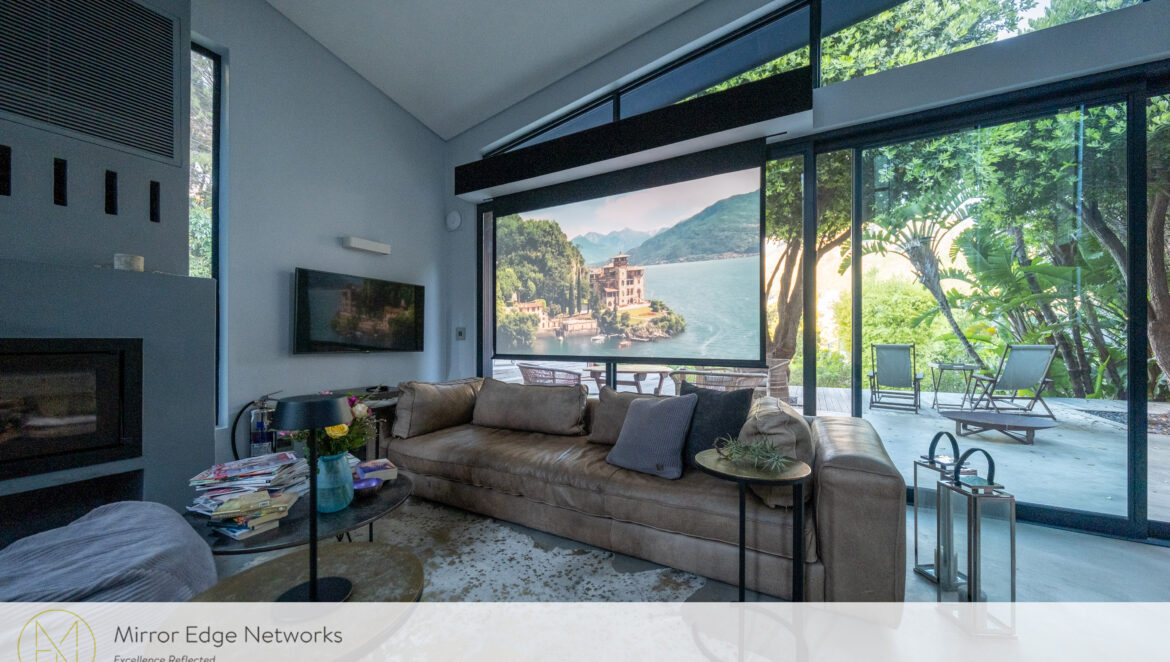

A television can disappear into the ceiling, read as a mirror, or remain visible as artwork. A projection screen can retract after film night. These solutions all reduce visual clutter, but they solve different design problems. The right choice depends on what you want to see when the system is off, how the room is used, and how much space the architecture gives the mechanism.
Start with the room, not the mechanism
Before choosing a product, decide where people will sit, how large an image they actually need and what the wall, ceiling or cabinetry should look like when the system is idle. Daylight, reflections, available depth, structural support, ventilation and access for future servicing can change the answer. A solution that looks effortless in a photograph may require considerable planning behind the finished surface.
Mirror television: useful when a mirror belongs in the room
A mirror TV places a display behind reflective glass. Switched off, it reads as a mirror; switched on, the picture is visible through the glass. This can work well in a bathroom, dressing room or bedroom where the mirror has a genuine purpose and a conventional black screen would interrupt the interior.
The glass is still visible when the television is off. Light in the room, viewing angle, display brightness, mounting and service access therefore matter. A mirror TV is not simply a standard television hidden behind any piece of glass. Our hidden AV page shows an installation in both mirror and viewing modes.
Motorised TV lift: the display disappears completely
If the brief is to see no screen at all when it is not in use, a lift or drop-down mechanism is often a better fit. The display might rise from furniture or lower from a ceiling detail. This demands a clear travel path, suitable support, power and signal routes that tolerate movement, and a safe way to access the system for maintenance.
In our Val de Vie whole-home project, a bespoke mechanism by Definition Automation lowers the main-bedroom television from the ceiling and rotates it into viewing position. Mirror Edge Networks integrated it with the wider AV and Control4 system. The result is a calm bedroom when the screen is retracted, with straightforward operation when it is needed.
Hidden projection: a larger picture without a permanent screen
Projection is attractive when the aim is a much larger image for films or shared viewing, but a fixed display would dominate the room. The screen can retract into a ceiling or purpose-built enclosure. The projector, loudspeakers and light control still need a place in the design; hiding the screen alone does not make the whole cinema disappear.
Our Hout Bay hidden cinema is an open-plan living room with a motorised screen and front loudspeakers concealed within one custom enclosure. The everyday television remains available for casual viewing. Lowering the projection screen changes the character of the room without turning the living area into a permanent cinema.
Sometimes the projector itself needs to move. In the Oranjezicht cinema, a custom motorised drawer engineered with Definition Automation moves the client’s ultra-short-throw projector into its viewing position. The blinds also close when cinema mode is activated. That solution was designed for the particular room; it is not a standard drawer to add after the finishes are complete.
What about a television that shows art?
An art-style television such as Samsung’s Frame is a different compromise. The display remains on the wall, but careful placement, concealed cabling and artwork when idle can make it feel less intrusive. It may be more practical where the room cannot accommodate a moving mechanism. It should be chosen as a visible design element, not described as fully hidden AV.
Five questions to settle before specifying anything
- Must the screen disappear completely, or is a mirror or framed display acceptable?
- Is the priority everyday television, occasional large-format cinema, or both?
- What space is available for the display, mechanism, cabling and service access?
- How will daylight, reflections, blinds and loudspeaker positions affect the experience?
- Who will coordinate the joinery or building work, moving mechanism, AV system and control sequence?
These answers usually narrow the options quickly. See more hidden AV examples, or tell us about your room so we can assess what is realistic before a mechanism or display is ordered.